What 15 Untracked Hours Could Be Costing Your Firm

Count every email. Every site visit. Every revision round. Every “quick” call that somehow turned into 45 minutes.
Most design firm principals don’t actually know how they spend their time. And the gap between hours worked and hours invoiced is often a silent drain on profitability.
Your P&L may show a profit. Your bank account may look healthy. But you’re booked solid, exhausted, and somehow the math never feels quite as good as it should.
Let’s talk about why that happens — and what to do about it.
The Two Numbers Every Principal Should Know
Effective Hourly Rate
Your effective hourly rate is your total revenue divided by the total hours you actually worked.
Not your stated rate.
Not what your proposal says.
What you truly earned.
If your rate is $150/hour, but your effective hourly rate ends up closer to $90/hour, scope creep or underpricing is likely happening somewhere along the way.
Utilization Rate
Your utilization rate is the percentage of your working time spent on billable client work.
A low utilization rate often points to hidden capacity loss like:
Excess revisions
Administrative work
Client communication
Project management overflow
Untracked labor
In other words: time you are working, but not getting paid for.
What This Looks Like in Real Life
Let’s say you charge $150 an hour and bill 25 hours on a project. On paper, that’s a $3,750 project.
But once you sit down and count everything, you realize you actually worked closer to 40 hours.
Two extra site visits.
A revision round you never logged.
Vendor coordination that ran long.
Emails that slowly turned into extended problem-solving sessions.
None of it billed.
You charged $150 an hour, but you actually earned $93.75.
That means $2,250 of work quietly walked out the door unpaid.
And if this pattern repeats across 15 projects in a year, it can create a major cash flow and profit problem — even if revenue looks healthy on the surface.

Why Your Books Don’t Automatically Catch This
This surprises a lot of designers.
Whether you pay yourself through payroll or owner’s draws, your personal labor usually isn’t tied directly to individual projects inside your bookkeeping system.
So while your reports may show profit, they often don’t account for the most expensive resource in your business: your time.
That’s why time tracking matters so much.
It adds context to the numbers.

How to Get a Clearer Picture of Project Profitability
You do not need to overhaul your bookkeeping system overnight.
Start with three simple steps:
Determine your internal cost rate
Figure out what your time realistically costs the business.Track your hours by project
Log the hours you personally spend on each project.Compare time against profit
Use that data to identify which projects, services, or clients are actually profitable.
The goal is not perfection.
The goal is clarity.
Because clarity helps you:
Price more confidently
Spot scope creep earlier
Understand your most profitable services
Make smarter hiring decisions
Protect your margins
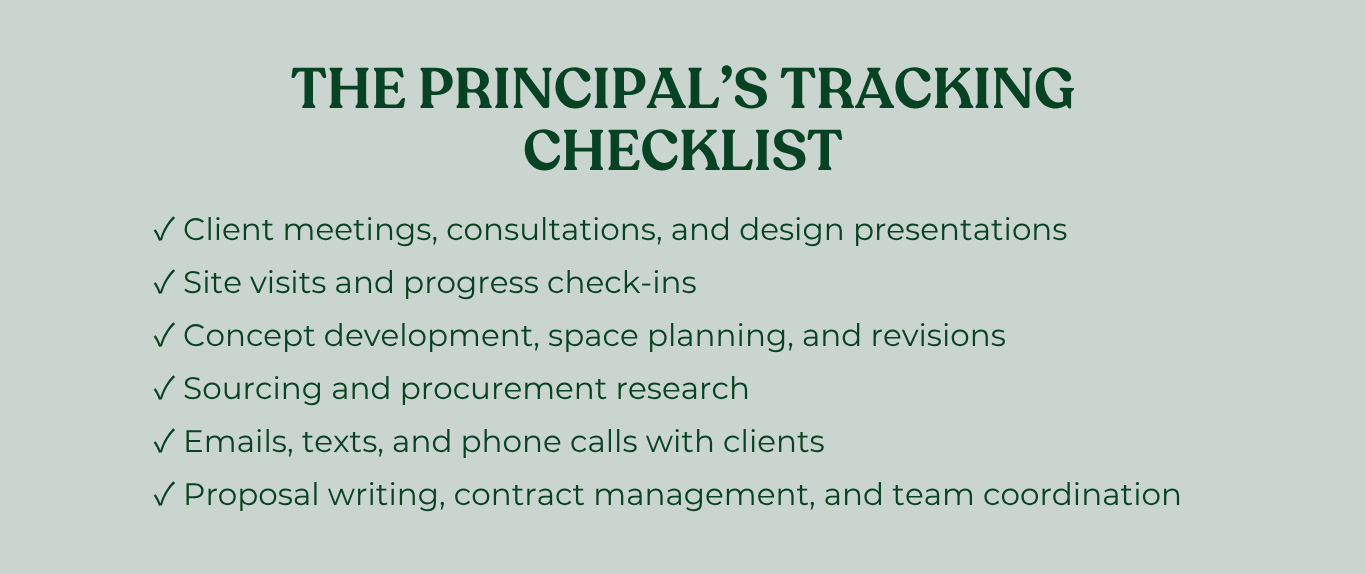
What Should You Track?
Anything project-related:
Emails
Client calls
Site visits
Revisions
Vendor coordination
Administrative follow-up
And honestly? The tool matters less than consistency.
At the beginning, don’t overcomplicate it. Just start tracking by project name and look for patterns.
Where to Start:
This Week
Choose a time tracking tool and begin logging your hours consistently.
This Month
Compare tracked hours against your invoices and identify gaps.
This Quarter
Review profitability by project type and adjust pricing or scope accordingly.
What Changes Once You Have the Data
Once you have clean time data sitting next to your financial reports, your decision-making changes.
You begin to clearly see:
Which projects are truly profitable
Which clients consume the most margin
Where pricing needs adjustment
Whether your workload is sustainable
When it’s time to hire
Most importantly, you stop pricing based on assumptions and start pricing based on data.
Your Books Should Tell the Full Story
At Business by the Book, we help interior design firms connect operational data with financial reporting so they can understand true project profitability — in plain English.
Because profitable businesses are not built on revenue alone.
They are built on clarity.

Sherry & Morgan lead Business by the Book, a women owned bookkeeping and accounting firm serving interior designers and creative businesses nationwide.